What Is a DOI and How Do You Get One for Your Paper
Princeton Journal of Pre-Collegiate Research
TL;DR: A DOI (Digital Object Identifier) is a permanent, unique code assigned to a published academic work. It ensures your paper can be found and cited reliably, no matter where it is hosted online. This post explains what a DOI is, why it matters for student researchers, and how published papers receive one. Students who publish through the Princeton Journal of Pre-Collegiate Research receive a DOI on every accepted paper automatically.
Why DOIs matter more than most students realise
Most high school students who complete original research never think about what happens to their paper after it is written. They submit it to a journal, wait for a decision, and if accepted, assume the work is now "published." What they often do not realise is that a published paper without a DOI is nearly invisible to the academic world. Search engines, citation managers, and university databases all rely on DOIs to locate, index, and link to published work. Without one, your paper exists in name only.
Understanding what a DOI is, and how you get one for your paper, is essential knowledge for any student pursuing credible academic publication.
What is a DOI and how do you get one for your paper?
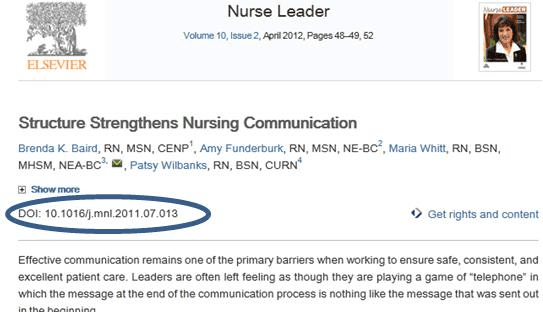
A DOI (Digital Object Identifier) is a permanent alphanumeric code assigned to a digital document, most commonly a published academic paper. It takes the form of a URL beginning with https://doi.org/ followed by a unique string (for example, https://doi.org/10.1000/xyz123). Once assigned, a DOI never changes, even if the paper moves to a different server or website. Authors do not apply for a DOI directly. The journal or publisher that accepts your paper registers the DOI on your behalf through an official registration agency.
What does a DOI actually do?
A DOI functions as a permanent address for your paper. Think of it as a forwarding address that always routes to the correct location, regardless of where the paper is physically hosted. The International DOI Foundation (IDF), which oversees the DOI system, reports that over 300 million DOIs have been registered to date across academic publishing, government data, and research datasets.
For a student researcher, a DOI does three specific things. First, it makes your paper citable. Researchers using tools like Zotero, Mendeley, or Google Scholar can import your paper's full citation data by entering the DOI alone. Second, it makes your paper discoverable. Academic databases and library catalogues index papers by DOI, which means your work becomes searchable beyond the journal's own website. Third, it signals credibility. A DOI indicates that your paper passed through a formal publication process with a registered publisher, not simply that it was posted online.
Who assigns DOIs, and how does the process work?
DOIs are assigned by organisations called registration agencies, which are accredited by the International DOI Foundation. The most widely used registration agency in academic publishing is Crossref. Journals register with Crossref (or another accredited agency), pay an annual membership fee, and then submit metadata for each paper they publish. Crossref assigns the DOI and maintains the permanent link.
As an author, you do not register a DOI yourself. You cannot purchase one directly. The journal that publishes your paper handles the entire process. This is one concrete reason why the journal you choose to publish in matters: only journals with an active Crossref membership can issue legitimate DOIs.
What happens after your paper is accepted and before the DOI is issued?
Acceptance is not the final step. Between acceptance and DOI assignment, a journal completes several tasks: final copyediting, metadata entry (author names, abstract, keywords, volume and issue numbers), layout formatting, and DOI registration with Crossref. For larger journals, this process can take weeks. For student journals with streamlined workflows, it can be faster. The DOI is typically issued at the moment of formal online publication, not at acceptance.
This distinction matters because some journals tell students their paper is "accepted" long before it is formally published with a DOI. An acceptance letter is not a DOI. Until the DOI is live and resolves to your paper, the publication is not complete in the academic sense. When evaluating where to submit your work, confirm that the journal issues DOIs through a recognised registration agency such as Crossref.
What are the most common mistakes students make about DOIs?
The most frequent mistake is assuming that any online publication automatically comes with a DOI. It does not. A paper posted on a school website, a personal blog, or even some student journal platforms has no DOI unless the publisher has registered it through an accredited agency. Students sometimes list these publications on college applications or CVs as peer-reviewed, DOI-indexed work when they are not. Admissions officers and academic reviewers who check the DOI link will find nothing, which undermines the student's credibility rather than supporting it.
The second common mistake is confusing a URL with a DOI. A paper's web address can change if the journal moves its hosting platform. A DOI is permanent precisely because it is managed by a separate registry. Citing a paper by its URL alone is unreliable; citing it by DOI is the academic standard.
The third mistake is submitting to journals that promise DOIs but are not registered with Crossref or another legitimate agency. Some predatory or low-credibility journals generate DOI-style strings that do not resolve through the official doi.org resolver. Before submitting, verify the journal's Crossref membership at search.crossref.org by searching for the journal's name.
The fourth mistake is submitting a paper before it is ready, in the hope of getting a DOI quickly. Peer-reviewed journals that issue legitimate DOIs are selective. Submitting an underdeveloped paper to a credible journal results in rejection, which delays the process. A paper worth citing is worth finishing properly first.
How to make sure your published paper receives a legitimate DOI: a step-by-step guide
Verify the journal's Crossref membership. Go to search.crossref.org and search for the journal by name. If it appears as a registered member, it can issue legitimate DOIs. If it does not appear, the journal cannot issue a DOI through the standard academic registry.
Confirm the journal's peer review process. A DOI from a non-peer-reviewed source carries less academic weight. Confirm that the journal uses qualified reviewers and that the process is clearly described on its website. Review the Princeton Journal of Pre-Collegiate Research peer review standards as a reference point for what a credible process looks like.
Prepare your manuscript to submission standards. Journals reject papers for formatting errors as often as for content gaps. Read the submission guidelines carefully before formatting your document. Review the PJPCR submission guidelines for a concrete example of what a structured submission process requires.
Submit your paper and complete the peer review process. This includes responding to reviewer feedback and revising your manuscript as requested. Peer review is not a formality. Expect substantive comments and treat them as an opportunity to strengthen the work.
Confirm DOI assignment at publication. When your paper is formally published, the journal will provide your DOI. Test it immediately at doi.org to confirm it resolves correctly. Save this DOI for your CV, college applications, and any future citations of your own work.
List the DOI accurately in all citations and applications. When referencing your published paper, always include the full DOI link. This is what makes the work verifiable to anyone who reads your application or CV.
PJPCR accepts original research across all academic disciplines. If your research is complete and ready for peer review, review the submission guidelines at princeton-jpcr.org.
Frequently asked questions about DOIs for student researchers
What is a DOI in simple terms?
A DOI (Digital Object Identifier) is a permanent, unique code assigned to a published academic document. It takes the form of a URL starting with https://doi.org/ and always links to the paper, regardless of where it is hosted. It is the standard way academic work is identified, cited, and indexed across databases worldwide.
How long does it take to get a DOI after a paper is accepted?
DOI assignment happens at formal publication, not at acceptance. The time between acceptance and publication varies by journal, typically ranging from a few days to several weeks depending on the journal's editorial workflow, copyediting requirements, and publication schedule. Acceptance alone does not trigger DOI registration.
Do I need a university affiliation to get a DOI for my paper?
No. University affiliation is not required. DOIs are assigned by the journal that publishes your work, not by your institution. High school students publishing in peer-reviewed journals that hold Crossref membership receive DOIs on the same basis as any other author. Your school's prestige or your grade level is not a factor in DOI eligibility.
What makes a DOI credible versus one that is not legitimate?
A legitimate DOI resolves correctly when entered at doi.org and is registered by a journal with active Crossref membership. A non-legitimate DOI-style string either does not resolve at all or leads to a page not indexed by Crossref. Before citing a DOI or listing a publication on an application, test the link at doi.org and verify the journal at search.crossref.org.
Does the Princeton Journal of Pre-Collegiate Research assign DOIs to published papers?
Yes. Every paper published in the Princeton Journal of Pre-Collegiate Research receives a DOI. The journal is an open-access, peer-reviewed publication, and DOI assignment is part of its standard publication process. Authors do not need to request a DOI separately; it is assigned automatically upon formal publication. You can review published work and verify DOI assignment at princeton-jpcr.org.
What you should take away from this
A DOI is not a bonus feature of academic publishing. It is the mechanism that makes your published work citable, discoverable, and credible to anyone who encounters it. You cannot apply for one yourself; the journal you publish in either has the infrastructure to issue one or it does not. That distinction should inform where you choose to submit your research.
Verify Crossref membership before you submit. Confirm that peer review is genuine. Prepare your manuscript to the journal's stated standards. And when your paper is published, test the DOI link and record it accurately for every future use.
If your research is ready for peer review and formal publication, submit it to PJPCR at princeton-jpcr.org.
Read More

APA format for high school research papers: complete guide
By
RISE Research
Read more

MLA format for research papers: when and how
By
RISE Research
Read more

APA vs MLA vs Chicago: which to use for your paper
By
RISE Research
Read more

How to cite a dataset
By
RISE Research
Read more

In-text citations vs footnotes: how each works
By
RISE Research
Read more

What is a p-value, explained for high school researchers
By
RISE Research
Read more

What is regression analysis and when do you use it
By
RISE Research
Read more

What is standard deviation and why it matters
By
RISE Research
Read more

What is a t-test and when do you need one
By
RISE Research
Read more

What is effect size and why reviewers care
By
RISE Research
Read more

Common statistical mistakes in student papers
By
RISE Research
Read more

Research for biology majors: what to publish before applying
By
https://princeton-jpcr.org/
Read more

Research for economics majors
By
https://princeton-jpcr.org/
Read more

Research for political science majors
By
https://princeton-jpcr.org/
Read more

Research for English and humanities majors
By
https://princeton-jpcr.org/
Read more

Research for neuroscience majors
By
https://princeton-jpcr.org/
Read more

Undecided major: what research keeps your options open
By
https://princeton-jpcr.org/
Read more

Summer research timeline: June to August week by week
By
Princeton Journal of Pre-Collegiate Research
Read more

Research goals to set at the start of the school year
By
Princeton Journal of Pre-Collegiate Research
Read more

How to finish your research paper before finals season
By
Princeton Journal of Pre-Collegiate Research
Read more

New year research resolutions that actually stick
By
Princeton Journal of Pre-Collegiate Research
Read more