How to Write an Introduction for a Research Paper
Princeton Journal of Pre-Collegiate Research
TL;DR: This post answers exactly how to write an introduction for a research paper at the high school or pre-collegiate level. It covers the four structural components every strong introduction must include, the most common mistakes that cause reviewers to reject papers at the first read, and a step-by-step process you can apply to your own work today. If your research is ready for peer review, the Princeton Journal of Pre-Collegiate Research accepts original student work across all academic disciplines.
Why the introduction is where most student papers fail
Peer reviewers form a judgment about a paper's quality within the first two paragraphs. That is not an opinion; it reflects how academic review actually works. A reviewer reading fifty submissions will move quickly past an introduction that does not establish context, state a clear problem, and signal methodological awareness. The paper may contain excellent data. It will not matter if the introduction does not earn continued reading.
Most high school students write introductions the way they were taught to write essay openers: broad context first, then a thesis at the end. That structure works for a five-paragraph essay. It does not work for a research paper. Knowing how to write an introduction for a research paper means understanding a different set of rules entirely, and this guide gives you those rules in full.
How do you write an introduction for a research paper?
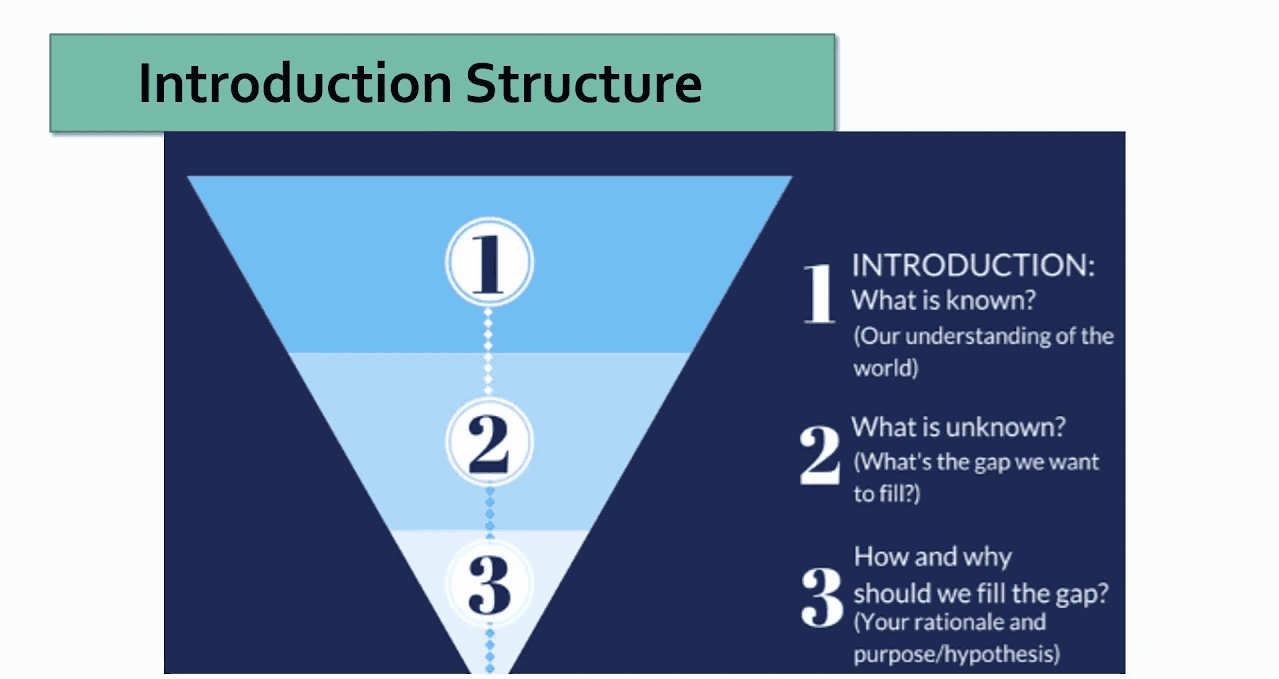
A strong research paper introduction does four things in order: it establishes the broader context of the topic, identifies a specific gap or unresolved problem in the existing literature, states the purpose or research question of your study, and briefly signals your approach. Every sentence in the introduction should serve one of these four functions. If it does not, cut it.
This structure is sometimes called the CARS model (Create a Research Space), developed by applied linguist John Swales in 1990 and still used in academic writing instruction at universities worldwide. It gives you a reliable framework regardless of your discipline.
Here is how each component works in practice:
Establish the territory (2-4 sentences). Introduce the broad topic and explain why it matters. Keep this tight. You are not writing a history of the field. You are orienting the reader to the conversation your paper enters. One or two well-chosen citations from peer-reviewed sources signal that you know the literature.
Identify the gap (2-3 sentences). This is the most important move in the introduction. Name what is unknown, contested, or understudied. Phrases like "however, little research has examined" or "existing studies have not addressed" do this work. The gap is your justification for doing the study at all. Without it, your paper has no clear reason to exist.
State your research question or purpose (1-2 sentences). Be direct. "This study investigates..." or "This paper examines..." is the correct register. Do not bury your research question in a subordinate clause. State it plainly so a reviewer can immediately evaluate whether your methodology addresses it.
Signal your approach (1-2 sentences). Briefly indicate what kind of study this is: experimental, survey-based, archival, computational, or otherwise. You do not need to describe your methodology in full here. You need to give the reader enough to know what kind of evidence is coming.
A well-constructed introduction for a high school research paper typically runs between 200 and 400 words. Longer is not better. Reviewers at peer-reviewed journals, including those who evaluate submissions to PJPCR, are reading for precision, not volume.
What separates a publishable introduction from a class assignment?
The single biggest difference is the literature gap. A class assignment introduction can assert that a topic is interesting or important. A publishable introduction must demonstrate that something specific is missing from what researchers already know, and that your study addresses that specific gap.
This requires you to have actually read the literature. Not summaries of the literature. Not abstracts. The papers themselves, or at minimum a credible selection of them. When you read primary sources, you begin to notice what questions they leave open, what populations they exclude, what variables they do not measure. That noticing is where your research question comes from. And the introduction is where you make that gap visible to your reader.
A second difference is citation practice. A class essay might cite sources to support claims. A research paper introduction cites sources to map the existing conversation. You are showing the reader what has already been said so that your contribution is legible against that background. Use a consistent citation format (APA, MLA, or Chicago, depending on your discipline) from the first draft. Reviewers notice inconsistency immediately.
A third difference is tone. Academic introductions do not use rhetorical questions, personal anecdotes, or dramatic opening statements. They begin with a claim about the field, not a claim about the writer's experience. "Adolescent sleep deprivation has been associated with reduced academic performance in multiple longitudinal studies" is a strong opening sentence. "Have you ever wondered why teenagers are always tired?" is not.
What are the most common mistakes students make when writing a research paper introduction?
The four mistakes below account for the majority of introduction-related revision requests at peer-reviewed student journals. Each one is fixable once you know what to look for.
Starting too broad. Many students open with a sentence like "Throughout human history, people have been interested in..." This adds no information and signals to reviewers that the writer does not yet know how to enter an academic conversation. Fix: begin with a specific, sourced claim about the current state of research in your exact topic area.
Skipping the gap entirely. Some introductions establish context and then jump directly to "therefore, this study will..." without identifying what is missing from existing research. Without the gap, there is no justification for the study. Fix: after your context paragraph, write one explicit sentence that names what existing research has not yet addressed. Make the gap visible.
Overstating the research question. High school researchers sometimes frame their question as if it will resolve a major scientific debate. Reviewers are skeptical of overclaiming. A study conducted with 40 survey respondents cannot "definitively establish" anything. Fix: use precise, bounded language. "This study explores" or "this paper examines" is accurate. "This paper proves" is not.
Treating the introduction as a summary of the paper. The introduction is not an abstract. It does not summarise your findings. It sets up the question. Results and conclusions belong in their own sections. Fix: read your introduction and remove any sentence that describes what you found. If you want to signal your findings briefly, one sentence at the end of the introduction is the maximum.
How to write a research paper introduction, step by step
Use this sequence when drafting your introduction from scratch. It works for STEM papers, social science studies, humanities research, and interdisciplinary work.
Write the gap statement first. Before you write anything else, write one sentence that names what is missing from existing research. This is the core of your introduction. Everything else is built around it.
Identify 3-5 sources that establish the territory. Use Google Scholar or a university database to find peer-reviewed papers on your topic. Read their introductions. Notice how they frame the conversation. These are your context sources.
Draft the context paragraph. Write 2-4 sentences that introduce the broader topic and cite 1-2 of your sources. Do not summarise every paper. Establish the conversation.
Draft the gap paragraph. Write 2-3 sentences that identify the specific unresolved problem your study addresses. Use your gap statement from step one as the anchor.
State your research question. Write one or two sentences that state your purpose directly. "This study examines..." or "This paper investigates..."
Add the approach signal. One or two sentences describing your methodology type. Keep it brief.
Revise for length and precision. Cut any sentence that does not serve one of the four functions. Target 200-400 words total.
When your full paper is complete and your introduction has been revised with feedback, review the PJPCR submission resources for guidance on preparing your manuscript for peer review.
PJPCR accepts original research across all academic disciplines from pre-collegiate students. If your paper is ready, review the submission guidelines at princeton-jpcr.org.
Frequently asked questions about how to write an introduction for a research paper
What is the purpose of a research paper introduction?
The purpose of a research paper introduction is to establish the context of your study, identify a gap in existing knowledge, state your research question, and signal your methodological approach. It is not a summary of your findings. It is the argument for why your study needed to be done. A strong introduction typically runs 200-400 words.
Every sentence in the introduction should serve one of these four functions. If a sentence does not establish context, identify a gap, state the question, or signal the approach, it does not belong in the introduction. Reviewers use the introduction to assess whether the research question is clearly defined and whether the study is positioned within the existing literature.
How long should a research paper introduction be?
For most high school and pre-collegiate research papers, the introduction should be between 200 and 400 words. In longer papers (above 5,000 words), introductions may extend to 500-600 words. Length should be determined by what the four structural components require, not by a word count target.
Shorter is usually better. A concise introduction that clearly states the gap and research question is stronger than a long introduction that repeats context in multiple ways. If your introduction exceeds 500 words in a standard-length paper, it likely contains sentences that belong in the literature review, not the introduction.
Do I need prior research experience to write a strong introduction?
No. You need to have read the relevant literature carefully and identified a genuine gap. Prior research experience helps, but the introduction is a writing skill, not a credential. High school students with no prior publications regularly write strong introductions once they understand the CARS structure: establish territory, identify the gap, state the purpose, signal the approach.
What matters is that you have engaged seriously with existing sources on your topic. The introduction reflects your understanding of the field, not your biography. A student writing their first research paper can produce a publication-ready introduction if they have done the reading and applied the structure correctly.
What makes a research paper introduction credible to peer reviewers?
A credible introduction cites peer-reviewed sources, identifies a specific and genuine gap in the literature, states a bounded and testable research question, and avoids overclaiming. Reviewers look for evidence that the writer knows the field and has positioned their study honestly within it.
Credibility is damaged by three things: unsourced claims presented as established fact, a research question so broad it cannot be addressed by the study's methods, and an introduction that reads like a general essay rather than an entry into a specific academic conversation. Precision is the primary signal of credibility at the introduction stage.
What kinds of research does the Princeton Journal of Pre-Collegiate Research publish?
The Princeton Journal of Pre-Collegiate Research (PJPCR) publishes original, peer-reviewed research by high school students across STEM fields, social sciences, humanities, and interdisciplinary topics. Submissions are evaluated on the quality of the research question, methodology, and written presentation, not on the prestige of the student's school.
PJPCR does not guarantee acceptance. All submissions go through a genuine peer review process. The journal is open-access and free to submit. Published work receives a DOI, making it permanently citable in academic contexts. Detailed submission criteria are available at princeton-jpcr.org.
What to do now
Writing a strong introduction comes down to four moves executed in order: establish the territory, name the gap, state the question, signal the approach. Every sentence earns its place by serving one of those functions. The most common failure is skipping the gap, which removes the justification for the entire study.
Read your current introduction against the CARS framework. If the gap is missing or vague, that is your revision priority. If the research question is buried or overclaimed, rewrite it as a single direct sentence. If the opening is too broad, replace it with a specific sourced claim about the current state of research in your exact topic area.
If your research is ready for peer review, submit it to the Princeton Journal of Pre-Collegiate Research at princeton-jpcr.org.
Read More

APA format for high school research papers: complete guide
By
RISE Research
Read more

MLA format for research papers: when and how
By
RISE Research
Read more

APA vs MLA vs Chicago: which to use for your paper
By
RISE Research
Read more

How to cite a dataset
By
RISE Research
Read more

In-text citations vs footnotes: how each works
By
RISE Research
Read more

What is a p-value, explained for high school researchers
By
RISE Research
Read more

What is regression analysis and when do you use it
By
RISE Research
Read more

What is standard deviation and why it matters
By
RISE Research
Read more

What is a t-test and when do you need one
By
RISE Research
Read more

What is effect size and why reviewers care
By
RISE Research
Read more

Common statistical mistakes in student papers
By
RISE Research
Read more

Research for biology majors: what to publish before applying
By
https://princeton-jpcr.org/
Read more

Research for economics majors
By
https://princeton-jpcr.org/
Read more

Research for political science majors
By
https://princeton-jpcr.org/
Read more

Research for English and humanities majors
By
https://princeton-jpcr.org/
Read more

Research for neuroscience majors
By
https://princeton-jpcr.org/
Read more

Undecided major: what research keeps your options open
By
https://princeton-jpcr.org/
Read more

Summer research timeline: June to August week by week
By
Princeton Journal of Pre-Collegiate Research
Read more

Research goals to set at the start of the school year
By
Princeton Journal of Pre-Collegiate Research
Read more

How to finish your research paper before finals season
By
Princeton Journal of Pre-Collegiate Research
Read more

New year research resolutions that actually stick
By
Princeton Journal of Pre-Collegiate Research
Read more