How to Write an Abstract for a High School Research Journal
Princeton Journal of Pre-Collegiate Research
Your abstract is the first thing an editor, peer reviewer, or reader encounters. Get it wrong, and your research may never receive the attention it deserves. Learning how to write an abstract for a high school research journal is not a minor formatting task. It is a foundational skill that determines whether your work is taken seriously from the first line.
This guide walks you through every component of a strong abstract, explains what reviewers are actually looking for, and shows you how to present your research with the clarity and precision that credible academic journals expect.
What an Abstract Actually Does
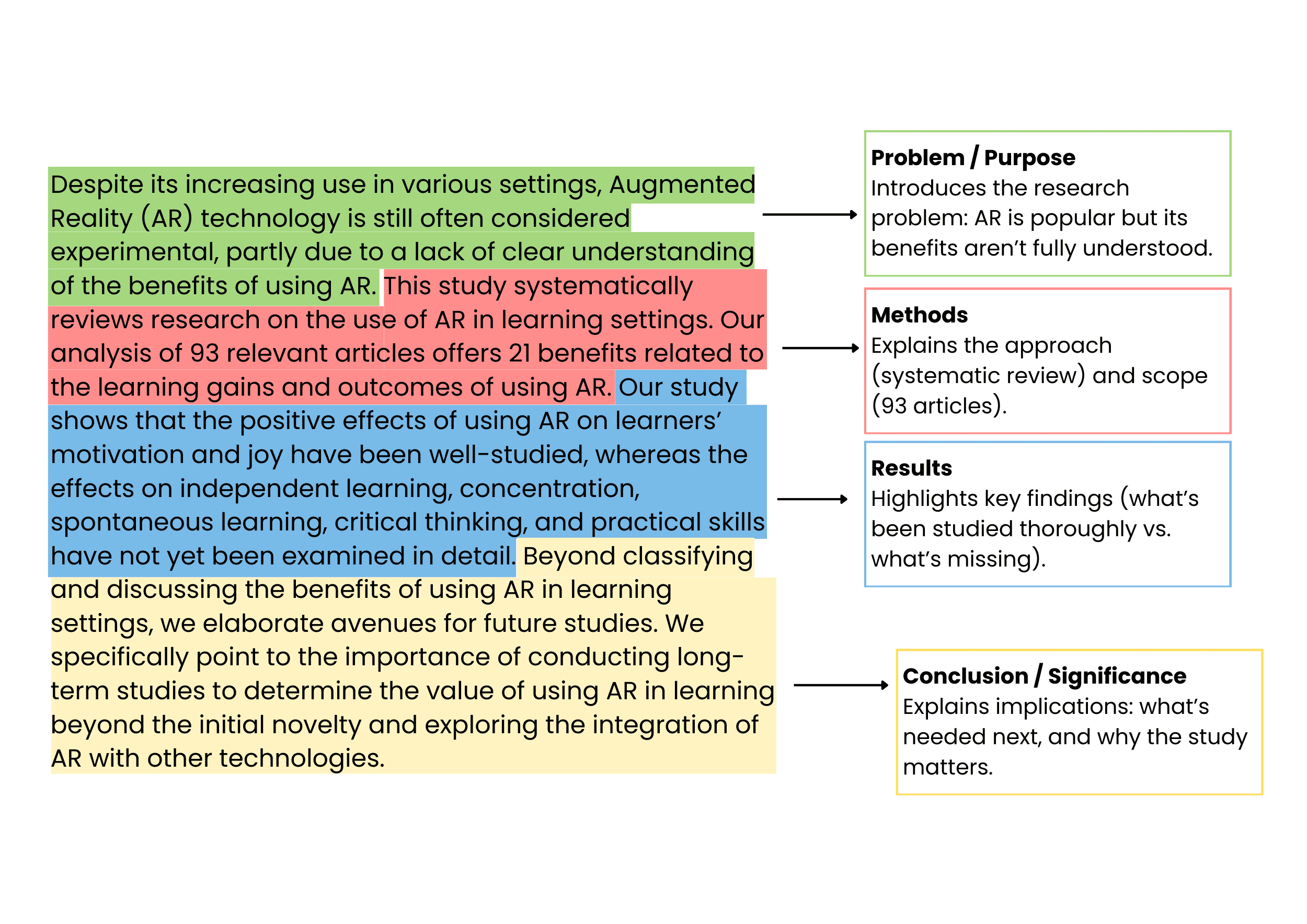
An abstract is a self-contained summary of your entire research paper. It is not an introduction. It is not a teaser. It is a compressed, complete representation of your study: what you investigated, how you investigated it, what you found, and why it matters.
Most peer-reviewed journals, including those that publish pre-collegiate research, use abstracts as a primary screening tool. Reviewers decide within the first few sentences whether a submission merits deeper evaluation. Your abstract must communicate competence, originality, and rigor before the reader reaches page one of your paper.
For high school researchers submitting to competitive academic journals, the abstract carries additional weight. It signals that you understand the conventions of scholarly communication. That signal matters.
The Four Core Components Every Abstract Must Include
Regardless of your discipline (STEM, humanities, social sciences, or interdisciplinary fields), a well-constructed abstract contains four essential elements. Each one serves a distinct purpose. Each one must be present.
1. The Problem or Research Question
Open by identifying the gap, problem, or question your research addresses. Be specific. Vague problem statements ("This paper explores climate change") signal unfocused research. Precise problem statements ("This study examines the relationship between urban heat island intensity and socioeconomic stratification in mid-sized U.S. cities") signal rigorous, purposeful inquiry.
You do not need to justify why the topic matters in general terms. Readers of academic journals already understand why research matters. Your job is to define exactly what your study addresses and why that specific question has not been adequately answered before.
2. The Methodology
Describe how you conducted your research. This section should be brief but precise. Include your research design, data sources, analytical methods, and any instruments or frameworks you applied.
For quantitative studies, name your statistical approach. For qualitative studies, name your analytical framework (thematic analysis, discourse analysis, case study methodology, etc.). For experimental research, describe your experimental design and controls. Reviewers need to assess whether your methods are appropriate for your research question. Give them enough to make that judgment.
3. The Results or Findings
State what you actually found. This is the section most student researchers underwrite. They summarize their methods in detail and then offer a vague gesture toward results ("The findings suggest several interesting patterns"). That is not acceptable in a peer-reviewed context.
Report your key findings directly. If your study is quantitative, include specific values or effect sizes where space allows. If your study is qualitative, name the primary themes or conclusions your analysis produced. Specificity here is what separates a credible abstract from a superficial one.
4. The Conclusion and Implications
Close by stating what your findings mean. What do they contribute to the existing literature? What practical, theoretical, or policy implications follow from your results? This does not need to be lengthy. Two to three sentences that clearly articulate your study's contribution are sufficient and far more effective than a paragraph of hedged speculation.
How to Write an Abstract for a High School Research Journal: Structure and Length
Most high school research journals, including those modeled on university-level publication standards, expect abstracts between 150 and 300 words. Some journals specify a maximum; always check the submission guidelines before drafting. If no limit is stated, 200 to 250 words is a reliable target.
Write your abstract as a single paragraph. Do not use subheadings within the abstract itself. Do not use bullet points. The abstract is prose, and it must flow as a coherent, unified summary rather than a fragmented list of components.
Use past tense when describing what you did and what you found ("This study examined...", "Results indicated..."). Use present tense when stating conclusions or implications that remain true ("These findings suggest...", "This research contributes..."). Consistency in tense signals careful, deliberate writing.
Common Mistakes That Undermine Abstracts
Understanding how to write an abstract for a high school research journal also means understanding what to avoid. The following errors appear frequently in student submissions and weaken otherwise strong research.
Citing Sources in the Abstract
Do not include citations in your abstract. The abstract must stand alone. Reviewers and readers should be able to understand your research entirely from the abstract without consulting your reference list. If you feel compelled to cite something, that is a sign you are contextualizing rather than summarizing. Save the context for your introduction.
Using Jargon Without Definition
Your abstract will be read by reviewers who may not share your precise subspecialty. Avoid highly technical acronyms or field-specific terminology unless you define them on first use. This does not mean writing for a general audience. It means writing with enough clarity that a competent scholar adjacent to your field can follow your argument without confusion.
Overpromising in the Problem Statement
High school researchers sometimes frame their problem statements with sweeping claims ("This research will resolve the longstanding debate over..."). Experienced reviewers recognize this immediately as a red flag. Frame your problem statement with precision and appropriate scope. A well-bounded research question is a sign of intellectual maturity, not limitation.
Omitting Actual Results
This bears repeating because it is the most common failure. An abstract that describes your research question and methodology but offers no specific results is incomplete. Reviewers will note the absence. If your study is preliminary or ongoing, acknowledge that explicitly and report what partial findings you do have. Do not leave the results section empty or vague.
Writing the Abstract First
Write your abstract last. This is counterintuitive but critical. Your abstract summarizes a completed argument. Until your paper is finished, you do not fully know what that argument is. Draft your full paper, refine your conclusions, and then write the abstract as a distillation of what you have already built.
Discipline-Specific Considerations
The four-component structure above applies across disciplines, but the emphasis and language shift depending on your field. Knowing these differences will help you calibrate your abstract appropriately.
STEM and Natural Sciences
Prioritize methodological precision and quantitative results. Reviewers in these fields expect specificity: sample sizes, experimental conditions, statistical outcomes, and effect magnitudes. Qualitative descriptions of results are insufficient. If your experiment produced measurable data, your abstract should reflect that.
Social Sciences
Clearly identify your theoretical framework and your unit of analysis. Social science abstracts should specify whether the study is empirical or theoretical, and whether the methodology is qualitative, quantitative, or mixed. Policy implications, where relevant, belong in the conclusion section of your abstract.
Humanities
Humanities abstracts follow the same four-component logic, but the "methodology" section often describes your interpretive framework, primary sources, and analytical approach rather than an experimental design. State your argument clearly. Humanities research produces arguments, not findings in the scientific sense. Your abstract should make that argument legible from the first sentence.
A Practical Checklist Before You Submit
Before submitting your abstract to any peer-reviewed journal, run through this checklist. Every item should be satisfied.
Research question is specific and clearly stated (not broad or vague)
Methodology is named and briefly described (not just implied)
Results are reported with specificity (not summarized in general terms)
Conclusion states your contribution (not just what you hope future research will do)
Word count falls within the journal's specified range (check submission guidelines)
No citations appear in the abstract
Tense is used consistently and correctly
The abstract reads as a single, coherent paragraph
No undefined acronyms or unexplained jargon
The abstract was written after the paper was completed
Why This Matters Beyond Submission
Learning how to write an abstract for a high school research journal is not just about clearing an editorial hurdle. It is about developing a transferable skill that will serve you through undergraduate research, graduate applications, conference presentations, and professional scholarship.
Abstracts are indexed. When your paper receives a DOI and enters academic databases, your abstract becomes the public-facing representation of your research. It is what other scholars read when deciding whether to cite your work. It is what university admissions readers encounter if they search for your published research. The quality of your abstract directly affects the reach and impact of your study.
At Princeton JPCR, every submission undergoes rigorous peer review. Reviewers evaluate your abstract as part of that process. A strong abstract does not guarantee acceptance, but a weak one signals problems that reviewers will look for throughout the manuscript. Your abstract sets the standard you are claiming to meet.
How to Write an Abstract for a High School Research Journal: Final Guidance
Write with precision. Avoid generality. Report what you actually found, not what you hoped to find or what you think the field needs. Keep your language clear and your claims proportionate to your evidence.
The abstract is 200 words representing months of work. Every sentence carries weight. Write accordingly.
If you have conducted original, mentored research and are ready to submit to a peer-reviewed journal that holds student work to genuine academic standards, explore Princeton JPCR's submission process. Your research deserves a publication venue that takes it seriously. So does your abstract.
Read More

APA format for high school research papers: complete guide
By
RISE Research
Read more

MLA format for research papers: when and how
By
RISE Research
Read more

APA vs MLA vs Chicago: which to use for your paper
By
RISE Research
Read more

How to cite a dataset
By
RISE Research
Read more

In-text citations vs footnotes: how each works
By
RISE Research
Read more

What is a p-value, explained for high school researchers
By
RISE Research
Read more

What is regression analysis and when do you use it
By
RISE Research
Read more

What is standard deviation and why it matters
By
RISE Research
Read more

What is a t-test and when do you need one
By
RISE Research
Read more

What is effect size and why reviewers care
By
RISE Research
Read more

Common statistical mistakes in student papers
By
RISE Research
Read more

Research for biology majors: what to publish before applying
By
https://princeton-jpcr.org/
Read more

Research for economics majors
By
https://princeton-jpcr.org/
Read more

Research for political science majors
By
https://princeton-jpcr.org/
Read more

Research for English and humanities majors
By
https://princeton-jpcr.org/
Read more

Research for neuroscience majors
By
https://princeton-jpcr.org/
Read more

Undecided major: what research keeps your options open
By
https://princeton-jpcr.org/
Read more

Summer research timeline: June to August week by week
By
Princeton Journal of Pre-Collegiate Research
Read more

Research goals to set at the start of the school year
By
Princeton Journal of Pre-Collegiate Research
Read more

How to finish your research paper before finals season
By
Princeton Journal of Pre-Collegiate Research
Read more

New year research resolutions that actually stick
By
Princeton Journal of Pre-Collegiate Research
Read more