How to Turn Class Notes Into a Research Question
Princeton Journal of Pre-Collegiate Research
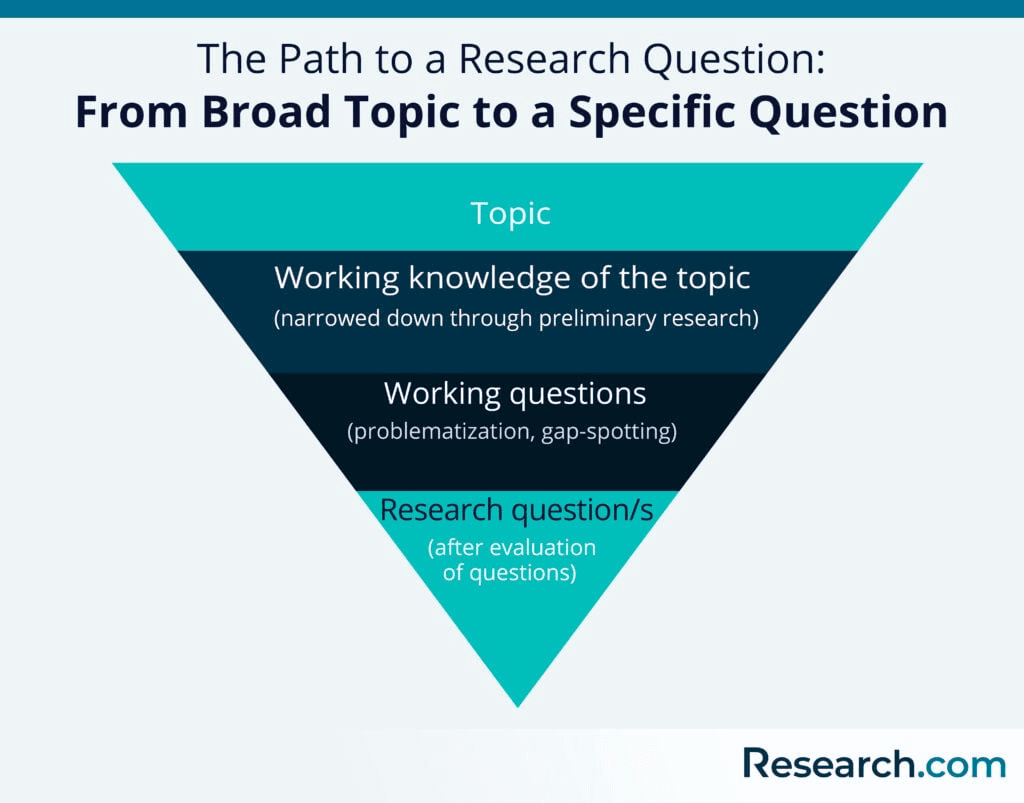
TL;DR: This post answers a specific question that most research guides skip: how to turn class notes into a research question worth pursuing. It is written for high school students in grades 9 to 12 who have not yet chosen a research topic but want to start from what they already know. After reading, you will be able to identify gaps in your course material, sharpen a curiosity into a testable question, and evaluate whether that question is original enough to publish. When your question is ready to become a paper, the Princeton Journal of Pre-Collegiate Research publishes original student research across all academic disciplines.
Why class notes are a better starting point than a blank page
Most research guides tell students to "find something they are passionate about." That advice produces paralysis, not papers. The students who move fastest from idea to submission are the ones who start with something concrete: a unit they just finished, a textbook claim that felt incomplete, or a question a teacher answered with "that is beyond the scope of this course." Those moments are not distractions. They are the raw material for original research. Learning how to turn class notes into a research question is one of the most practical skills a student researcher can develop, and almost no one teaches it explicitly.
Your class notes already contain the scaffolding. They show you what is established, what is contested, and what is simply not covered. The gap between those three categories is where research lives.
How do you turn class notes into a research question?
You turn class notes into a research question by identifying a claim, finding, or topic in your notes that is stated without full explanation, then asking why, under what conditions, or for whom that claim holds. A strong research question names a specific variable, population, or context that your course material left unexamined. Most students can generate a viable research question from any unit of study in under an hour using this method.
Here is how to work through the process systematically.
Step 1: Read your notes as a critic, not a student. Go through one unit of notes and mark every sentence that contains a qualifier: "often," "in some cases," "research suggests," "it is believed that." These qualifiers signal that the claim is not settled. They are invitations to investigate further.
Step 2: List the "why" and "how" questions your notes do not answer. For each marked sentence, write one question that the original claim does not resolve. If your biology notes say "stress hormones affect memory consolidation," your question might be: "Does the timing of stress exposure relative to learning affect how much information is retained?" That is specific, testable, and not answered by a standard high school curriculum.
Step 3: Check whether your question has a known answer. A research question is only original if the answer is not already widely documented. Search Google Scholar and PubMed (for sciences) or JSTOR (for humanities and social sciences) using the key terms in your question. If the first page of results answers your question directly, narrow it. Change the population, the context, or the timeframe. If you need help identifying where the existing literature ends and the gap begins, the guide on what is a research gap and how do you find one walks through that process in detail.
Step 4: Apply the FINER criteria. A good research question is Feasible (you can actually study it), Interesting (it matters beyond your classroom), Novel (it adds something new), Ethical (it does not harm participants), and Relevant (it connects to existing knowledge). This framework, used in graduate-level research training, applies equally well to high school work. If your question fails on Feasibility, the fix is usually narrowing the scope, not abandoning the topic.
Step 5: Write the question in one sentence. If you cannot state your research question in a single clear sentence, it is not yet focused enough. "What is the effect of X on Y in population Z under condition W?" is the structure to aim for. Vague questions produce vague papers.
What makes a class-note question different from a publishable research question?
A class-note question is a curiosity. A publishable research question is a curiosity with a defined scope, a connection to existing literature, and a methodology that could actually answer it. The difference is not intelligence. It is specificity.
Consider the difference between these two questions generated from the same unit on climate science. "How does climate change affect ecosystems?" is a class-note question. It is too broad to answer in a single study. "How has the timing of spring snowmelt in alpine meadows shifted over the past 30 years in the Rocky Mountains, and what does that predict for pollinator activity windows?" is a research question. It names a specific phenomenon, a measurable variable, a geographic scope, and a timeframe. A student with access to publicly available USGS snowpack data and published pollinator studies could actually investigate it.
The shift from the first question to the second does not require a university lab. It requires precision. That precision is what reviewers at academic journals assess first. A paper that answers a narrow question well is more publishable than a paper that gestures at a broad one. This is the single most important distinction between a strong class essay and a paper ready for peer review. For more on what that transition looks like in practice, the post on how to come up with a research question in high school covers the framing process from multiple angles.
What are the most common mistakes students make when forming a research question from class notes?
The most common mistake is treating the textbook claim as the research question itself. If your notes say "social media use is linked to adolescent anxiety," that is a finding, not a question. Writing a paper that summarises existing evidence for that link is a literature review, not original research. Original research requires you to test something, measure something, or analyse a dataset in a way that produces a new finding.
The second mistake is choosing a question that is too broad to answer with available resources. Students frequently ask questions that would require multi-year longitudinal studies or controlled laboratory conditions. The fix is to narrow the scope to something achievable: a specific age group, a defined time period, a publicly available dataset, or a survey you can administer yourself. The guide on how to design a survey for a research study is useful here if your question involves human participants.
The third mistake is skipping the literature review before committing to a question. According to the National Institutes of Health's guidance on research design, a literature review is not optional preparation. It is the step that confirms your question has not already been answered. Students who skip it often spend months on a paper that reviewers reject at the desk-screening stage because the question lacks novelty.
The fourth mistake is confusing a hypothesis with a research question. A research question is open-ended: it asks what, how, or whether. A hypothesis is a directional prediction about what the answer will be. Both are necessary, but they are not interchangeable. If you need help distinguishing them, the post on how to write a research hypothesis covers the difference precisely.
How to turn class notes into a research question, step by step
Choose one unit from a course you have recently completed. Pick a topic where you remember feeling that the explanation was incomplete or that the teacher acknowledged ongoing debate.
Read through your notes and highlight every qualifying phrase: "often," "in many cases," "some researchers argue," "evidence suggests."
For each highlighted phrase, write one question that the original claim does not answer. Aim for at least five candidate questions.
Run each candidate question through a 10-minute Google Scholar search. If the question is already fully answered in the literature, mark it as "answered" and move on. If the literature is partial or contested, mark it as "viable."
Take your viable questions and apply the FINER criteria. Eliminate any question that fails on Feasibility or Ethics.
Rewrite the remaining question in the format: "What is the effect of [variable] on [outcome] in [population or context]?" Tighten until it fits one sentence.
Check that your question implies a methodology. If you cannot identify whether it calls for a survey, an experiment, a secondary data analysis, or a literature synthesis, the question is still too vague. The post on qualitative research vs quantitative research can help you identify the right approach.
PJPCR publishes original research across all academic disciplines, including work developed directly from high school coursework. If your question has reached the stage where you have a methodology and preliminary findings, review the submission guidelines at the PJPCR blog for guidance on formatting and next steps.
Frequently asked questions about turning class notes into a research question
What is a research question and how is it different from a topic?
A research question is a specific, answerable inquiry that drives a study. A topic is a subject area. "Climate change" is a topic. "How has the frequency of category 4 and 5 Atlantic hurricanes changed between 1980 and 2020, and what role does sea surface temperature play?" is a research question. The difference matters because a topic cannot be tested. A research question can.
How long does it take to develop a research question from class notes?
Most students can generate a viable candidate question in one to two hours using a structured process. Narrowing it to a publishable question, after a literature review and methodology check, typically takes one to two weeks of focused work. Rushing this stage is the most common reason student papers are rejected at the desk-screening stage before peer review even begins.
Do I need a mentor or lab access to develop a research question from class notes?
No. Developing a research question requires analytical thinking and access to academic databases, not laboratory equipment or institutional affiliation. Many publishable student papers are based on secondary data analysis, systematic literature reviews, or surveys, all of which are accessible without a university sponsor. Mentor support is valuable but not a prerequisite for identifying a strong question.
What makes a research question strong enough to publish?
A publishable research question is specific, novel, and methodologically feasible. It names a defined variable, population, or context. It has not been fully answered in the existing literature. And it implies a method of investigation that the student can realistically execute. Reviewers assess all three criteria. A question that is interesting but unanswerable with available resources will not survive peer review.
What kinds of research does PJPCR publish, and can it include work developed from a class topic?
PJPCR publishes original, peer-reviewed research by high school students across STEM, humanities, social sciences, and interdisciplinary fields. Work developed from a class topic is entirely eligible, provided it presents original findings or analysis rather than summarising existing knowledge. The standard review and publication timeline is 2 to 3 months. A fast-track option is available for students who need a quicker turnaround. Review the submission guidelines to confirm your paper meets the criteria before submitting.
Your class notes are already a research archive
Every unit you have studied contains claims that are partial, contested, or context-dependent. Those are not gaps in your education. They are invitations to do original work. The process of turning class notes into a research question is systematic, not mysterious: identify a qualified claim, ask what it leaves unanswered, narrow that question to something testable, and confirm it is novel. Students who follow this process consistently produce stronger first drafts than students who start from scratch with a blank topic list.
The most important step is the one most students skip: the literature review before committing to a question. Do that work early, and everything that follows becomes faster and more focused.
If your research question has developed into a complete study with findings, submit it to PJPCR at princeton-jpcr.org. Submission is free, peer review is rigorous, and published work is openly accessible to readers worldwide.
Read More

APA format for high school research papers: complete guide
By
RISE Research
Read more

MLA format for research papers: when and how
By
RISE Research
Read more

APA vs MLA vs Chicago: which to use for your paper
By
RISE Research
Read more

How to cite a dataset
By
RISE Research
Read more

In-text citations vs footnotes: how each works
By
RISE Research
Read more

What is a p-value, explained for high school researchers
By
RISE Research
Read more

What is regression analysis and when do you use it
By
RISE Research
Read more

What is standard deviation and why it matters
By
RISE Research
Read more

What is a t-test and when do you need one
By
RISE Research
Read more

What is effect size and why reviewers care
By
RISE Research
Read more

Common statistical mistakes in student papers
By
RISE Research
Read more

Research for biology majors: what to publish before applying
By
https://princeton-jpcr.org/
Read more

Research for economics majors
By
https://princeton-jpcr.org/
Read more

Research for political science majors
By
https://princeton-jpcr.org/
Read more

Research for English and humanities majors
By
https://princeton-jpcr.org/
Read more

Research for neuroscience majors
By
https://princeton-jpcr.org/
Read more

Undecided major: what research keeps your options open
By
https://princeton-jpcr.org/
Read more

Summer research timeline: June to August week by week
By
Princeton Journal of Pre-Collegiate Research
Read more

Research goals to set at the start of the school year
By
Princeton Journal of Pre-Collegiate Research
Read more

How to finish your research paper before finals season
By
Princeton Journal of Pre-Collegiate Research
Read more

New year research resolutions that actually stick
By
Princeton Journal of Pre-Collegiate Research
Read more