Active vs passive voice in academic writing: which to use
Princeton Journal of Pre-Collegiate Research
One of the most debated stylistic choices in scholarly work is active vs passive voice in academic writing: which to use and when. Students, researchers, and professors often receive contradictory advice — some instructors demand passive voice for objectivity, while others insist on active voice for clarity. The truth is more nuanced than either extreme suggests. Understanding the strengths and limitations of each voice will help you make deliberate, informed choices that strengthen your writing and meet the expectations of your discipline.
In this guide, we will break down exactly what active and passive voice are, explore how different academic disciplines approach them, and give you practical rules for deciding which to use in any given sentence.
What Is Active Voice?
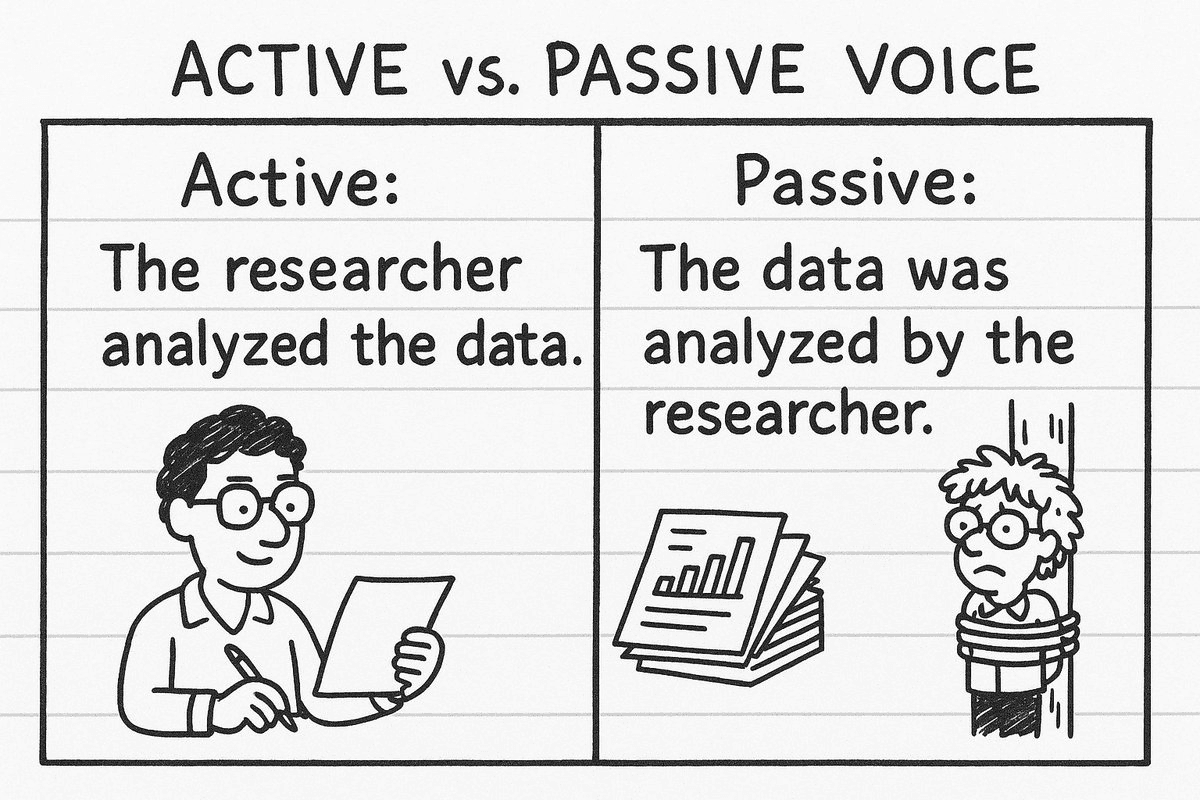
In an active voice sentence, the grammatical subject performs the action described by the verb. The structure follows a straightforward pattern: Subject → Verb → Object.
Example: The researcher analyzed the data.
Here, "the researcher" is the subject doing the action ("analyzed"), and "the data" is the object receiving it. Active voice sentences tend to be shorter, more direct, and easier to read. They place emphasis on the agent — the person or thing doing the action — which can make arguments feel more assertive and accountable.
Active voice is generally preferred in disciplines such as the humanities, social sciences, and business writing because it produces clear, engaging prose. The American Psychological Association (APA), for example, explicitly encourages active voice in most contexts, noting that it reduces ambiguity and improves readability.
What Is Passive Voice?
In a passive voice sentence, the grammatical subject receives the action rather than performing it. The structure typically follows: Object → "to be" verb + past participle → (by + agent, optional).
Example: The data were analyzed by the researcher.
The agent ("the researcher") can also be omitted entirely: The data were analyzed. This omission is one reason passive voice is so common in scientific writing — it shifts focus from who did something to what was done, which can feel more objective and impersonal.
Passive constructions use a form of the verb "to be" (is, are, was, were, has been, will be) combined with a past participle. Recognizing this pattern helps you identify passive voice in your own writing.
Active vs Passive Voice in Academic Writing: Which to Use by Discipline
The debate over active vs passive voice in academic writing: which to use often comes down to disciplinary conventions. There is no single universal rule — context matters enormously.
Sciences and Engineering
Passive voice has historically dominated scientific writing, particularly in methods sections. Sentences like "Samples were collected from three sites" or "The solution was heated to 100°C" are standard because they emphasize the procedure rather than the people performing it. This convention reinforces the idea that scientific results should be reproducible regardless of who conducts the experiment.
However, modern scientific style guides, including those published by the American Chemical Society and many journal editors, now encourage a mix. Active voice is increasingly accepted — even preferred — in introductions, discussions, and conclusions, where the researcher's interpretation and argument take center stage.
Humanities
In literary criticism, history, and philosophy, active voice is strongly preferred. Humanities writing values a clear authorial voice and direct argumentation. Sentences like "Shakespeare critiques patriarchal authority in King Lear" or "This essay argues that colonialism shaped Victorian literature" are direct, confident, and expected. Excessive passive voice in humanities writing can make arguments seem evasive or unclear.
Social Sciences
The social sciences occupy a middle ground. APA style, used widely in psychology, sociology, and education, recommends active voice for most writing but acknowledges that passive voice is appropriate when the action is more important than the actor. Quantitative research papers often use passive voice in methods sections while shifting to active voice in discussions.
Law and Business
Legal writing traditionally uses passive voice to maintain formality and avoid assigning blame directly. Business writing, by contrast, increasingly favors active voice for clarity and persuasion. Academic business writing tends to follow APA or similar guidelines that favor active constructions.
The Case for Active Voice in Academic Writing
There are compelling reasons why most modern style guides lean toward active voice as the default choice:
Clarity: Active sentences make it immediately clear who is doing what. Readers do not have to reconstruct the agent from context.
Conciseness: Active voice typically uses fewer words. Compare "The committee made the decision" (5 words after the subject) with "The decision was made by the committee" (7 words).
Engagement: Active prose feels more dynamic and confident, which helps maintain reader interest across long academic texts.
Accountability: Naming the agent of an action strengthens academic integrity. Instead of "It was concluded that...", writing "We concluded that..." makes the researcher's role transparent.
Reduced ambiguity: Passive constructions with omitted agents can create confusion about who is responsible for a claim or action.
The Case for Passive Voice in Academic Writing
Despite its reputation as a writing weakness, passive voice serves legitimate and important functions in academic contexts:
Objectivity: When the agent is unknown, irrelevant, or deliberately excluded to maintain an impersonal tone, passive voice is appropriate. "Participants were randomly assigned to groups" focuses on the procedure, not the researcher.
Emphasis on the object: Sometimes the receiver of the action is more important than the actor. "The ancient manuscript was discovered in 1947" emphasizes the manuscript, not whoever found it.
Avoiding repetition: If the subject has already been established, passive voice can provide stylistic variety and avoid awkward repetition.
Disciplinary convention: In fields where passive voice is the norm (certain sciences, legal writing), deviating too dramatically can make your work seem out of place or unprofessional.
Tact: Passive voice can soften criticism or avoid directly assigning blame, which may be appropriate in certain academic or professional contexts.
Common Mistakes to Avoid
Understanding the rules is only half the battle. Many writers make predictable errors when navigating voice in academic writing.
Overusing Passive Voice Out of Habit
Many students default to passive voice because it sounds "more academic." This is a misconception. Excessive passive voice makes writing wordy, evasive, and difficult to follow. If you find yourself writing sentences like "It is believed by many scholars that..." when you could write "Many scholars believe that...", choose the active version.
Using Passive Voice to Hide the Agent Inappropriately
Omitting the agent when it is actually important can weaken your argument or raise ethical concerns. In research writing, transparency about who conducted procedures, made decisions, or drew conclusions is essential. Do not use passive voice to obscure your own role in the research.
Inconsistency Within a Section
Switching randomly between active and passive voice within a paragraph disrupts flow and confuses readers. Decide on a dominant voice for each section based on its purpose, and shift deliberately rather than accidentally.
Confusing Passive Voice with Past Tense
These are different grammatical categories. "The researcher analyzed the data" is active voice in past tense. "The data were analyzed" is passive voice in past tense. Voice refers to the relationship between subject and action, not the time frame.
Practical Guidelines: How to Decide Which Voice to Use
When you are unsure whether to use active or passive voice in a specific sentence, ask yourself these questions:
Who or what is the focus of this sentence? If the focus is the agent (person or thing doing the action), use active voice. If the focus is the recipient of the action, passive voice may be more appropriate.
Is the agent known and relevant? If yes, name the agent and use active voice. If the agent is unknown or unimportant, passive voice is justified.
What does my discipline expect? Check your style guide and read published papers in your field to understand the conventions.
Does the passive construction add unnecessary words? If removing the passive construction makes the sentence shorter and clearer without losing meaning, choose active voice.
Am I using passive voice for a legitimate reason or just out of habit? Be honest with yourself. Intentional use of passive voice is a stylistic choice; unconscious overuse is a writing problem.
Revising for Voice: A Practical Exercise
One of the most effective ways to improve your control of voice is to revise a passage deliberately. Take a paragraph from your own writing and highlight every passive construction. Then ask whether each one is justified. Convert unjustified passive sentences to active voice and read the revised paragraph aloud. You will likely notice an immediate improvement in clarity and energy.
Here is a quick before-and-after example:
Before (heavy passive): "The hypothesis was tested by the research team. Significant results were found. It was concluded by the authors that further study is needed."
After (revised to active where appropriate): "The research team tested the hypothesis and found significant results. The authors concluded that further study is needed."
The revised version is shorter, clearer, and more direct without sacrificing any information.
Active vs Passive Voice in Academic Writing: Which to Use — Final Recommendations
To summarize the key principles around active vs passive voice in academic writing: which to use:
Use active voice as your default in most academic writing, especially in humanities, social sciences, and business disciplines.
Use passive voice strategically in methods sections of scientific papers, when the agent is unknown or irrelevant, or when disciplinary convention demands it.
Always check your style guide (APA, MLA, Chicago, ACS, etc.) for discipline-specific recommendations.
Avoid passive voice when it obscures important information, adds unnecessary words, or makes your argument seem evasive.
Aim for intentional, consistent use of voice throughout each section of your paper.
Mastering voice in academic writing is not about following a rigid rule — it is about developing the judgment to choose the construction that best serves your argument, your reader, and your discipline. With practice, these choices will become second nature, and your writing will be stronger for it.
Read More

Can high school students be peer reviewers
By
Princeton Journal of Pre-Collegiate Research
Read more

What reviewing other papers teaches you about your own
By
Princeton Journal of Pre-Collegiate Research
Read more

How to give useful feedback on a classmate's paper
By
Princeton Journal of Pre-Collegiate Research
Read more

Student editorial boards: how they work
By
Princeton Journal of Pre-Collegiate Research
Read more
How to write a peer review as a student
By
Princeton Journal of Pre-Collegiate Research
Read more

Peer review etiquette: tone, structure, fairness
By
Princeton Journal of Pre-Collegiate Research
Read more

Version control for research documents
By
Princeton Journal of Pre-Collegiate Research
Read more

Digital vs paper lab notebooks for students
By
Princeton Journal of Pre-Collegiate Research
Read more

Data management basics for student researchers
By
Princeton Journal of Pre-Collegiate Research
Read more

How to keep a lab notebook that reviewers trust
By
Princeton Journal of Pre-Collegiate Research
Read more

How to organize research files across a year-long project
By
Princeton Journal of Pre-Collegiate Research
Read more

How to document your data so you can defend it
By
Princeton Journal of Pre-Collegiate Research
Read more

How to write a grant proposal as a student
By
Princeton Journal of Pre-Collegiate Research
Read more

Free resources that replace research funding
By
Princeton Journal of Pre-Collegiate Research
Read more

Corporate and nonprofit programs that fund student research
By
Princeton Journal of Pre-Collegiate Research
Read more

Science fair grants and material stipends explained
By
Princeton Journal of Pre-Collegiate Research
Read more

Crowdfunding a student research project: does it work
By
Princeton Journal of Pre-Collegiate Research
Read more

How much does a research project actually cost
By
Princeton Journal of Pre-Collegiate Research
Read more

How to ask your school to fund your project
By
Princeton Journal of Pre-Collegiate Research
Read more

Grants for high school research projects: what exists
By
Princeton Journal of Pre-Collegiate Research
Read more

How to start a research club at your school
By
Princeton Journal of Pre-Collegiate Research
Read more