Grants for high school research projects: what exists
Princeton Journal of Pre-Collegiate Research

Grants for high school research projects: what exists and how to find them
This post answers the specific question of what grants for high school research projects actually exist, who offers them, and what students need to know before applying. It is written for students in grades 9 through 12 who have an original research idea or an ongoing project and need funding to move forward. After reading, a student will know which grant programmes are realistic to pursue, what reviewers typically require, and where to publish completed work. Students whose research is ready for peer review may submit it to the Princeton Journal of Pre-Collegiate Research, an open-access, peer-reviewed journal for pre-collegiate researchers across all disciplines.
Why funding is one of the least-discussed barriers in high school research
Grants for high school research projects are not widely advertised, and most guidance students receive focuses on methodology and writing rather than on the practical question of how to pay for materials, equipment, or data access. Yet the National Science Foundation has documented that access to research resources is among the most significant structural barriers for students outside well-funded school districts. A student designing an environmental chemistry study may need reagents costing several hundred dollars. A computer science student running large-scale computational experiments may need cloud computing credits. The absence of funding does not indicate that a project is not viable; it indicates that the student has not yet identified the right source. This post maps those sources precisely.
What grants for high school research projects actually exist?
Several categories of funding are available to high school researchers: national competitive grants, regional and state-level awards, school district and institutional micro-grants, corporate and foundation programmes, and science fair affiliated awards. The most accessible entry point for most students is a school district or science fair affiliated award, which typically requires a project proposal rather than a full application package. National grants are more competitive but carry greater recognition and larger award amounts.
The following are verified, active programmes as of the time of publication. Students should confirm current eligibility requirements and deadlines directly with each programme, as terms change annually.
Society for Science Regeneron Science Talent Search (STS) and ISEF: The International Science and Engineering Fair, administered by Society for Science, provides awards totalling more than nine million dollars annually across affiliated regional fairs and the international competition. Students whose projects advance through a regional fair become eligible for ISEF awards, which include both cash prizes and scholarship grants. Eligibility requires participation in an affiliated regional fair. The Society for Science website maintains a searchable directory of affiliated fairs by state and country.
American Chemical Society Project SEED: Project SEED is a paid summer research fellowship for economically disadvantaged high school students. It places students in university or industry laboratories for eight to ten weeks and provides a stipend. The programme is not a grant in the traditional sense but functions as funded research access, which removes the cost barrier for students who cannot self-fund laboratory work. Applications are submitted through local ACS sections.
Simons Foundation Simons Summer Research Program: This is a competitive, stipend-supported summer research programme at Stony Brook University for rising high school seniors in the New York area. Participants conduct original research under faculty mentorship and receive a stipend. The programme is highly selective and requires a strong academic record and a clear research interest.
Davidson Institute Fellows Scholarship: The Davidson Fellows Scholarship awards up to fifty thousand dollars to students under eighteen who have completed a significant piece of original work in science, technology, engineering, mathematics, literature, music, or philosophy. The award is based on a completed project, not a proposal, which means students must have finished their research before applying. This makes it a post-completion award rather than a funding mechanism for ongoing work.
Jack Kent Cooke Foundation Young Scholars Program: This multi-year programme provides financial support and academic resources to high-achieving students from low-income backgrounds beginning in seventh grade. Students who are already enrolled receive support that can be directed toward research-related expenses. It is not a standalone research grant but functions as a sustained resource for eligible students.
Local community foundations and school district innovation funds: Many school districts maintain small discretionary funds for student research projects, typically in the range of two hundred to one thousand dollars. These are rarely publicised on district websites but can be accessed by speaking directly with a science department head, a research coordinator, or an assistant principal for curriculum. Community foundations at the county or city level frequently offer student project grants in the same range. The Foundation Center (now Candid) maintains a searchable database of foundation grants at candid.org that students can filter by geography and eligibility.
What do grant reviewers actually look for in a high school research proposal?
Understanding what grant reviewers assess is as important as knowing which programmes exist. Most students who apply for grants for high school research projects for the first time underestimate how much reviewers weight feasibility over ambition. A proposal that describes a clearly bounded question, a realistic methodology, and a specific budget justification will consistently outperform a proposal with a larger scope and vague methods.
Grant reviewers at the pre-collegiate level are typically looking for four things. First, a clearly stated research question that is specific enough to be answerable within the student's available time and resources. Second, a methodology section that demonstrates the student understands how the data will be collected and analysed. Third, a budget that accounts for every line item and explains why each expense is necessary. Fourth, evidence that the student has considered what happens if the primary approach does not work.
Students who have already begun their research, even at a preliminary stage, are at a significant advantage over those submitting purely speculative proposals. Reviewers can assess whether a student genuinely understands the domain. A student who has run a pilot test, reviewed the relevant literature, or consulted with a subject-matter expert will demonstrate that competence clearly in the proposal narrative.
For students who want to understand how their statistical methods will be evaluated in both grant proposals and eventual publications, the post on statistical significance in high school research provides a precise explanation of the standards reviewers apply.
What are the most common mistakes students make when applying for research grants?
The most common errors in grant applications for high school research projects are specific and avoidable. Awareness of them before drafting an application substantially improves the likelihood of a competitive submission.
The first mistake is proposing a project that requires resources the grant cannot cover. A student applying for a five-hundred-dollar district micro-grant who lists laboratory reagents costing twelve hundred dollars has written a proposal that cannot be funded as written. Every budget must be scoped to the award size, or the student must identify multiple funding sources and explain how they will work together.
The second mistake is treating the research question as self-evidently important without explaining why. Reviewers are not specialists in every field. A student researching microplastic concentrations in local waterways must explain, in plain language, why that question matters and what gap in existing knowledge the project addresses. The literature review section of a grant proposal serves exactly this function, and students who omit it or treat it as a formality lose the opportunity to establish the significance of their work.
The third mistake is submitting a proposal without a named faculty advisor or institutional affiliation when one is available. Many grant programmes, particularly those requiring laboratory access, expect the proposal to name a supervising adult who has agreed to oversee the work. Students who approach a university faculty member, a local community college instructor, or even a qualified professional in the relevant field before submitting are substantially more competitive. For guidance on how to frame a research project for academic audiences, the post on what to look for in a high school research journal explains the standards that peer-reviewed publications apply, which overlap significantly with grant review criteria.
The fourth mistake is applying only to national competitions and overlooking local sources. The Davidson Fellows and Regeneron STS receive thousands of applications annually. Local community foundation grants and district innovation funds may receive fewer than twenty. The probability-adjusted return on effort often favours local applications, particularly for students in the early stages of a project who need seed funding rather than a major award.
How to identify and apply for grants for high school research projects, step by step
Define the research question precisely before searching for funding. Grant reviewers cannot evaluate a vague idea. A one-paragraph project summary, written before any application is opened, will clarify which programmes are appropriate matches.
Estimate the total cost of the project, broken into specific line items: materials, equipment, software licences, travel to data collection sites, and any fees associated with data access or laboratory use.
Search the Candid Foundation Directory at candid.org using the filters for geography, age eligibility, and subject area. Identify at least three local or regional sources before pursuing national competitions.
Contact the science department head or research coordinator at the student's school to ask whether a district innovation fund or internal grant exists. This conversation takes less than ten minutes and is frequently overlooked.
Identify whether the project requires institutional affiliation. If it does, approach a potential faculty supervisor at a local university, community college, or research institution. A brief, specific email explaining the project and the supervision request is sufficient as a first contact.
Draft the proposal with the following sections in order: research question, background and significance, methodology, timeline, budget with justification, and expected outcomes.
When the research is complete and the findings are ready for peer review, submit the paper to PJPCR at princeton-jpcr.org/submit.
PJPCR publishes original research across all academic disciplines, from biology and chemistry to social science and computer science. If your project has produced findings ready for peer review, review the submission guidelines at princeton-jpcr.org/submit.
Frequently asked questions about grants for high school research projects
What is a research grant for high school students?
A research grant for high school students is a financial award, typically ranging from a few hundred to several thousand dollars, provided by a foundation, government agency, corporation, or academic institution to support an original research project. Unlike a scholarship, a research grant is awarded for a specific project and may require reporting on how the funds were used. Most pre-collegiate grants are competitive and require a written proposal.
How long does it take to hear back after applying for a high school research grant?
Review timelines vary significantly by programme. Local district or community foundation grants may notify applicants within four to eight weeks. National competitions such as the Davidson Fellows Scholarship or Regeneron STS operate on fixed annual calendars, with decisions typically communicated three to five months after the submission deadline. Students should verify the specific timeline for each programme on the administering organisation's website before applying.
Do I need a faculty mentor to apply for a research grant in high school?
Not all grant programmes require a faculty mentor, but having one substantially strengthens most applications. Programmes that require laboratory access or university affiliation will typically require a named supervising researcher. For independent or computational projects, a mentor is not always mandatory but demonstrates to reviewers that the student has access to expert guidance. Students without an existing mentor connection can approach faculty at local universities directly with a brief project description.
What makes a high school research grant application competitive?
The most competitive applications share four characteristics: a specific, answerable research question; a realistic and detailed methodology; a budget that accounts for every expense; and evidence that the student has reviewed the relevant literature. Reviewers consistently report that the budget justification section is the most frequently underdeveloped part of student applications. A proposal that demonstrates the student understands both the science and the logistics of executing the project will outperform one that is scientifically ambitious but operationally vague. Students preparing for publication alongside their grant work may find the post on APA format for high school research papers useful for aligning their documentation standards with journal requirements from the start.
What kinds of research does PJPCR publish, and is it peer reviewed?
The peer review process at PJPCR is conducted by qualified reviewers across all disciplines the journal covers, including the natural sciences, social sciences, computer science, mathematics, and the humanities. Submission and peer review are free. A publication fee applies for accepted papers. The standard review and publication timeline is two to three months, and a fast-track option is available for students who need a quicker turnaround. Accepted papers are published open-access and freely available to the public. Browse published issues to see the range of disciplines and methodologies represented in the journal's archive.
What students who secure funding should do next
Identifying and applying for grants for high school research projects is a concrete, learnable process. The funding landscape is less centralised than it appears: local sources are underutilised, national competitions are not the only path, and a well-scoped proposal submitted to the right programme is competitive regardless of school size or location. The most important steps are defining the research question precisely before searching for funding, estimating costs at the line-item level, and identifying a supervising mentor where one is required or advantageous.
When the research is complete and the findings are ready for independent evaluation, peer-reviewed publication is the standard by which original student research is validated. If your research is ready for peer review, submit it to PJPCR at princeton-jpcr.org/submit.
Read More

How to write a grant proposal as a student
By
Princeton Journal of Pre-Collegiate Research
Read more
Free resources that replace research funding
By
Princeton Journal of Pre-Collegiate Research
Read more
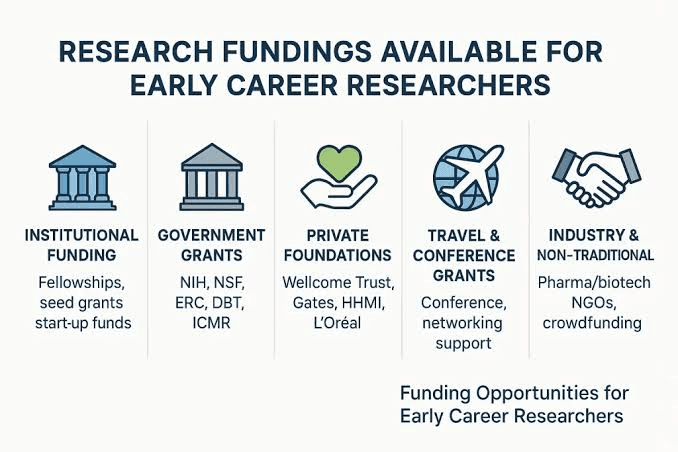
Corporate and nonprofit programs that fund student research
By
Princeton Journal of Pre-Collegiate Research
Read more

Science fair grants and material stipends explained
By
Princeton Journal of Pre-Collegiate Research
Read more

Crowdfunding a student research project: does it work
By
Princeton Journal of Pre-Collegiate Research
Read more

How much does a research project actually cost
By
Princeton Journal of Pre-Collegiate Research
Read more

How to ask your school to fund your project
By
Princeton Journal of Pre-Collegiate Research
Read more
Grants for high school research projects: what exists
By
Princeton Journal of Pre-Collegiate Research
Read more

How to start a research club at your school
By
Princeton Journal of Pre-Collegiate Research
Read more

How to organize a school research symposium
By
Princeton Journal of Pre-Collegiate Research
Read more

Turning a school club into a research pipeline
By
Princeton Journal of Pre-Collegiate Research
Read more

How to start a student research journal at your school
By
Princeton Journal of Pre-Collegiate Research
Read more

How to find a faculty sponsor for a research club
By
Princeton Journal of Pre-Collegiate Research
Read more

How to propose an independent study for research credit
By
Princeton Journal of Pre-Collegiate Research
Read more

Running a peer-review workshop at your school
By
Princeton Journal of Pre-Collegiate Research
Read more

How to get school funding for student research
By
Princeton Journal of Pre-Collegiate Research
Read more

How to do research as a team of students
By
Princeton Journal of Pre-Collegiate Research
Read more

Dividing work fairly in a group research project
By
Princeton Journal of Pre-Collegiate Research
Read more

Group research vs solo research: pros and cons
By
Princeton Journal of Pre-Collegiate Research
Read more

Resolving disagreements in group research
By
Princeton Journal of Pre-Collegiate Research
Read more

What to do when a co-author stops contributing
By
Princeton Journal of Pre-Collegiate Research
Read more