Dealing with imposter syndrome as a young researcher
Princeton Journal of Pre-Collegiate Research

Dealing with Imposter Syndrome as a Young Researcher: A Practical Guide
Dealing with imposter syndrome as a young researcher is one of the most common yet least discussed challenges in academia. You've earned your place in a lab, a graduate program, or a research team — and yet a persistent voice whispers that you don't truly belong, that your achievements are flukes, and that it's only a matter of time before everyone finds out. If this sounds familiar, you are far from alone. Studies suggest that up to 70% of people experience imposter syndrome at some point, and researchers — especially early-career ones — are particularly vulnerable.
This guide is designed to help you understand where these feelings come from, recognize how they manifest in research environments, and — most importantly — develop concrete strategies to move forward with confidence.
What Is Imposter Syndrome and Why Does It Hit Researchers So Hard?
Imposter syndrome was first identified by psychologists Pauline Clance and Suzanne Imes in 1978. They described it as an internal experience of intellectual phoniness — a belief that you are not as competent as others perceive you to be, despite clear evidence of your achievements.
Research environments are uniquely fertile ground for these feelings. Here's why:
Constant evaluation: From peer review to thesis defenses to grant applications, researchers are perpetually being judged by experts in their field.
Comparison culture: Academia rewards visible achievement, making it easy to compare your behind-the-scenes struggles with others' highlight reels.
Ambiguity of success: Unlike many professions, research rarely offers clear milestones. A failed experiment doesn't mean you're incompetent — but it can feel that way.
Steep learning curves: Early-career researchers are, by definition, learning. The gap between what you know and what your supervisors know can feel insurmountable.
Underrepresentation: Researchers from marginalized groups often face additional layers of imposter syndrome, compounded by systemic barriers and lack of visible role models.
Understanding the structural reasons behind these feelings is the first step toward dismantling them.
Dealing with Imposter Syndrome as a Young Researcher: Recognizing the Signs
Before you can address imposter syndrome, you need to recognize it in yourself. It doesn't always look like obvious self-doubt. Sometimes it hides in plain sight through behaviors that seem perfectly reasonable on the surface.
Common signs include:
Overworking: Putting in excessive hours not out of passion, but out of fear that you'll be exposed as inadequate if you don't.
Discounting praise: When your supervisor compliments your work, you immediately attribute it to luck or their low expectations rather than your skill.
Fear of asking questions: Staying silent in seminars or lab meetings because you're afraid a question will reveal how little you know.
Perfectionism paralysis: Delaying submissions, presentations, or publications because they're never quite good enough.
Attributing success externally: Believing your paper was accepted because the reviewers missed something, not because it was genuinely good.
Recognizing these patterns is not about self-criticism — it's about awareness. Once you can name what's happening, you can begin to respond differently.
The Psychological Roots: Why Your Brain Lies to You
Imposter syndrome is not a character flaw or a sign of weakness. It is, in large part, a cognitive distortion — a systematic error in thinking that leads you to misinterpret reality.
Two cognitive patterns are especially relevant for researchers:
The Dunning-Kruger Effect in Reverse: Most people have heard of the Dunning-Kruger effect, where people with limited knowledge overestimate their competence. But the reverse is equally real: highly competent people often underestimate their abilities precisely because they understand how much they don't know. The more you learn, the more aware you become of the vast landscape of knowledge you haven't yet explored. This awareness, while intellectually healthy, can feel emotionally crushing.
Confirmation Bias: Your brain is wired to seek out information that confirms existing beliefs. If you believe you're a fraud, you'll unconsciously collect evidence that supports this — a stumbled answer in a meeting, a rejected paper — while dismissing contradicting evidence like positive feedback or successful experiments.
Understanding these mechanisms won't make them disappear, but it gives you the power to question them when they arise.
Practical Strategies for Dealing with Imposter Syndrome as a Young Researcher
Knowledge alone rarely changes behavior. What you need are actionable strategies that you can implement in your daily research life. Here are approaches that have been shown to make a genuine difference.
1. Keep an Achievement Journal
Your brain is biased toward negative experiences. Counter this by deliberately recording your wins — no matter how small. Did you successfully run a new protocol today? Write it down. Did a colleague ask for your opinion on their methodology? Note it. Over weeks and months, this journal becomes concrete evidence against the narrative that you're incompetent. On difficult days, reading back through it can be genuinely transformative.
2. Talk About It — Especially with Peers
Imposter syndrome thrives in silence and isolation. One of the most powerful antidotes is discovering that the brilliant PhD student in the office next to you feels exactly the same way. Normalize these conversations with peers. You'll likely find that the people you most admire are also wrestling with self-doubt, which reframes the experience from a personal failing to a shared human challenge.
3. Reframe Failure as Data
In research, failure is not the exception — it is the method. Experiments fail. Hypotheses are disproven. Papers get rejected. Rather than interpreting these outcomes as evidence of your inadequacy, practice reframing them as information. A failed experiment tells you something important about the system you're studying. A rejected paper comes with reviewer comments that will make the work stronger. This is not toxic positivity — it is scientific thinking applied to your own career.
4. Seek Mentorship Intentionally
A good mentor doesn't just provide technical guidance — they provide perspective. Find someone, whether inside or outside your institution, who can offer an honest external view of your progress and potential. Many senior researchers are remarkably open about their own early struggles with self-doubt when asked directly. These conversations can be deeply reassuring and help you see your trajectory more accurately.
5. Distinguish Between Feeling Incompetent and Being Incompetent
This sounds simple, but it is profoundly important. Feelings are not facts. You can feel like a fraud while simultaneously producing rigorous, valuable research. Practice noticing when you're treating an emotional state as objective truth. Ask yourself: What is the actual evidence? What would I say to a colleague who described feeling this way? Often, the standards we apply to ourselves are ones we would never impose on others.
6. Set Boundaries Around Comparison
Social media, departmental newsletters, and conference programs are curated highlight reels. The colleague who just published in a top journal has not shared the eighteen months of rejection that preceded it. Be deliberate about limiting exposure to comparison triggers, and when comparison is unavoidable, try to use it as inspiration rather than a measuring stick for your own worth.
Building a Research Identity That Doesn't Depend on External Validation
One of the longer-term goals in overcoming imposter syndrome is developing what psychologists call intrinsic motivation — a sense of purpose and competence that comes from within rather than from external approval.
This means getting clear on why you do research. Not why you think you should, or why it looks impressive, but what genuinely drives your curiosity. When your sense of identity as a researcher is rooted in your values and intellectual interests rather than in grants won or papers published, external setbacks lose some of their power to destabilize you.
It also means developing what Carol Dweck calls a growth mindset — the belief that abilities are developed through effort and learning rather than fixed at birth. Researchers with a growth mindset interpret challenges as opportunities to develop rather than threats to their identity. This shift in perspective doesn't happen overnight, but it can be cultivated deliberately through the practices described above.
When to Seek Professional Support
Imposter syndrome exists on a spectrum. For many researchers, the strategies outlined here will be sufficient to manage self-doubt and keep it from derailing their work. But for others, these feelings are severe enough to cause significant anxiety, depression, or burnout — and in those cases, professional support is not a luxury but a necessity.
Many universities offer counseling services specifically for graduate students and early-career researchers. Cognitive behavioral therapy (CBT) has a strong evidence base for addressing the kinds of cognitive distortions that underlie imposter syndrome. If your self-doubt is significantly affecting your quality of life or your ability to function in your role, please reach out to a mental health professional.
You Belong Here: A Final Word on Dealing with Imposter Syndrome as a Young Researcher
Dealing with imposter syndrome as a young researcher is not about eliminating self-doubt entirely — some degree of intellectual humility is actually an asset in science. The goal is to prevent self-doubt from becoming self-sabotage.
You were admitted to your program, hired for your position, or invited to collaborate because someone with expertise looked at your potential and said yes. That decision was not an accident or a mistake. The discomfort you feel is not evidence that you don't belong — it is evidence that you are doing something genuinely challenging and that you care deeply about doing it well.
The researchers who seem most confident are not the ones who never doubt themselves. They are the ones who have learned to act despite the doubt. With time, practice, and the right support, you can do the same.
Your research matters. Your perspective matters. And you — imposter syndrome and all — belong exactly where you are.
Read More

How to write a grant proposal as a student
By
Princeton Journal of Pre-Collegiate Research
Read more
Free resources that replace research funding
By
Princeton Journal of Pre-Collegiate Research
Read more
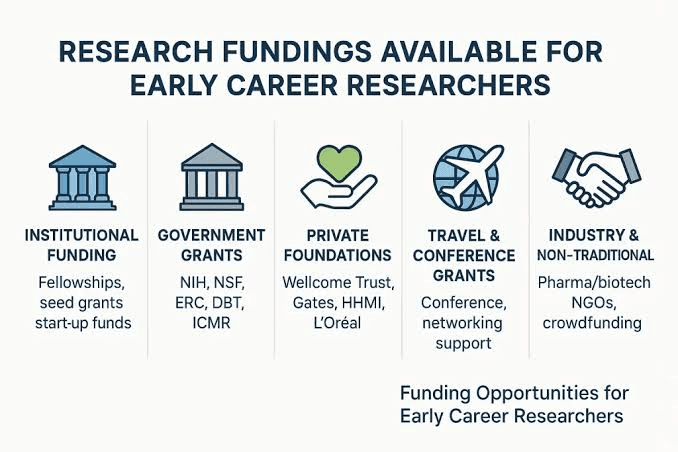
Corporate and nonprofit programs that fund student research
By
Princeton Journal of Pre-Collegiate Research
Read more

Science fair grants and material stipends explained
By
Princeton Journal of Pre-Collegiate Research
Read more

Crowdfunding a student research project: does it work
By
Princeton Journal of Pre-Collegiate Research
Read more

How much does a research project actually cost
By
Princeton Journal of Pre-Collegiate Research
Read more
How to ask your school to fund your project
By
Princeton Journal of Pre-Collegiate Research
Read more

Grants for high school research projects: what exists
By
Princeton Journal of Pre-Collegiate Research
Read more

How to start a research club at your school
By
Princeton Journal of Pre-Collegiate Research
Read more

How to organize a school research symposium
By
Princeton Journal of Pre-Collegiate Research
Read more

Turning a school club into a research pipeline
By
Princeton Journal of Pre-Collegiate Research
Read more

How to start a student research journal at your school
By
Princeton Journal of Pre-Collegiate Research
Read more

How to find a faculty sponsor for a research club
By
Princeton Journal of Pre-Collegiate Research
Read more

How to propose an independent study for research credit
By
Princeton Journal of Pre-Collegiate Research
Read more

Running a peer-review workshop at your school
By
Princeton Journal of Pre-Collegiate Research
Read more

How to get school funding for student research
By
Princeton Journal of Pre-Collegiate Research
Read more

How to do research as a team of students
By
Princeton Journal of Pre-Collegiate Research
Read more

Dividing work fairly in a group research project
By
Princeton Journal of Pre-Collegiate Research
Read more

Group research vs solo research: pros and cons
By
Princeton Journal of Pre-Collegiate Research
Read more

Resolving disagreements in group research
By
Princeton Journal of Pre-Collegiate Research
Read more

What to do when a co-author stops contributing
By
Princeton Journal of Pre-Collegiate Research
Read more