How to Write a Research Conclusion That Actually Concludes
Princeton Journal of Pre-Collegiate Research
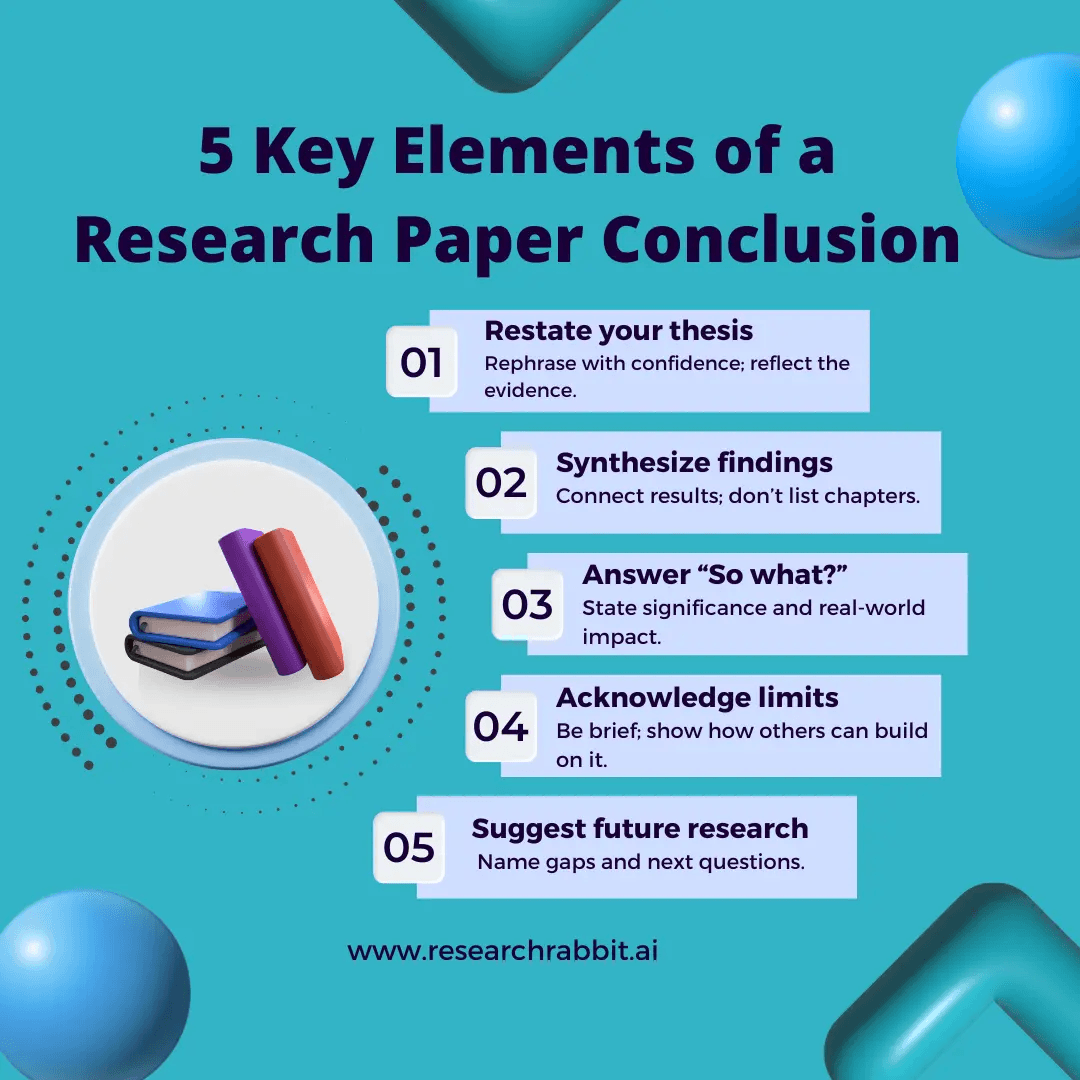
TL;DR: This post answers one specific question: how do you write a research conclusion that closes your argument rather than just restating it? It is written for high school students who have completed original research and are preparing a paper for submission or publication. After reading, you will know exactly what belongs in a conclusion, what does not, and how to avoid the structural errors that most reviewers flag immediately. If your paper is ready for peer review, the Princeton Journal of Pre-Collegiate Research publishes original student research across all academic disciplines.
Why most research conclusions fail before the last sentence
The most common reason a research conclusion fails is not weak writing. It is a structural problem: the student restates the introduction instead of closing the argument. Peer reviewers at academic journals identify this within the first two sentences of a conclusion. A conclusion that summarises what you did is not a conclusion. It is a second abstract.
Writing a strong research conclusion requires a different cognitive move than writing any other section. The introduction opens a question. The methods and results answer it. The conclusion explains what that answer means, why it matters, and what remains unresolved. Each of those three tasks is distinct. Conflating them produces the kind of conclusion that leaves reviewers writing "so what?" in the margin.
This guide walks through the structure of a conclusion that actually concludes: what to include, what to cut, and how to sequence the argument so your final section earns its place in the paper.
How do you write a research conclusion for a high school research paper?
A research conclusion has three parts: a direct answer to your research question, an explanation of what that answer contributes to the existing literature, and an honest account of your study's limitations and directions for future research. Each part is one to two paragraphs. The total length is typically 300 to 500 words for a standard high school research paper.
Start with your answer. Not a summary of your methods. Not a restatement of your hypothesis. The answer to the question you posed at the start of the paper. State it in one clear sentence. Then explain what that answer means in the context of the field.
According to the American Psychological Association's Publication Manual (7th edition), a conclusion should "clearly explain the contribution of the work" and "identify implications for theory, practice, or policy." That standard applies to student research as much as it applies to faculty publications. Reviewers trained in academic publishing hold student submissions to the same structural expectations.
Here is what each part of the conclusion should do:
Answer your research question directly. Use the exact language from your introduction. If your paper asked whether sleep deprivation affects short-term memory recall in adolescents, your conclusion opens by stating what your findings show about that relationship. Not "this study examined" but "this study found."
State the significance of that answer. Why does this finding matter? Does it support, complicate, or extend what prior research showed? One paragraph. Cite at least one source from your literature review to anchor the claim.
Acknowledge limitations honestly. Sample size, access to equipment, time constraints, geographic scope. Naming limitations is not a weakness. Omitting them is. Reviewers who find an unacknowledged limitation in your results section will note that you missed it in the conclusion.
Propose future research directions. What question does your finding open? What would a follow-up study need to do differently? This should be specific. "Future research should explore this further" is not a direction. "A longitudinal study tracking the same cohort over 12 months would clarify whether the effect persists" is.
Before drafting, review your research paper introduction and your discussion section side by side. The conclusion is not a repeat of either. If your discussion already addresses significance and limitations in depth, your conclusion synthesises those points rather than restating them at length.
What is the difference between a discussion section and a conclusion?
This is the question most students ask after they have written both sections and found they sound identical. The distinction is real and it matters structurally.
A discussion section interprets your results in detail. It explains why specific findings emerged, compares them to prior studies, and works through the implications of each data point. It is analytical and granular. A conclusion does not repeat that analysis. It synthesises it. The discussion asks "what do these results mean?" The conclusion asks "what does this paper now establish?"
Think of it this way: the discussion is where you do the interpretive work. The conclusion is where you deliver the verdict. A paper with a strong discussion and a weak conclusion leaves the reader doing the synthesis themselves. That is the writer's job, not the reader's.
One reliable test: read only your conclusion. Does it tell a reader who skipped the discussion what your paper found, why it matters, and what comes next? If not, the conclusion is not doing its job. It is borrowing its meaning from a section the reader may not have read carefully.
If you are working on the discussion section and finding the boundary unclear, the guide on how to write a discussion section in a research paper draws that line precisely.
What are the most common mistakes students make when writing a research conclusion?
Three structural errors appear in the majority of student research conclusions that reviewers flag for revision. Each one is predictable and fixable.
Mistake 1: Restating the abstract. Students who are uncertain what belongs in a conclusion default to summarising the whole paper again. The result reads like a second abstract. Reviewers notice immediately because the language mirrors the opening section almost word for word. The fix: your conclusion should not begin with "this study examined" or "in this paper, we investigated." It should begin with what you found.
Mistake 2: Introducing new evidence. A conclusion is not the place to cite a source you did not use in the body of the paper, introduce a new dataset, or raise a finding you did not analyse in the results section. New evidence in the conclusion signals to reviewers that the paper's structure is incomplete. If the evidence matters, it belongs in the body. If it does not belong in the body, it does not belong in the conclusion.
Mistake 3: Overstating the findings. This is the most consequential error because it affects the paper's credibility, not just its structure. A study of 47 high school students in one school district cannot establish a universal finding. A survey with a 34% response rate cannot be described as representative. The conclusion must match the scope of the evidence. Reviewers are trained to identify the gap between what a study shows and what the conclusion claims. The National Institutes of Health's reporting guidelines explicitly require that conclusions be "supported by the data presented."
Mistake 4: Vague future directions. "More research is needed" is not a future direction. It is a placeholder. Future research suggestions should name the specific gap your study leaves open and describe, in one sentence, what a follow-up study would need to do. Specificity here signals that you understand the limits of your own methodology. That understanding is what separates a publishable paper from a strong class assignment.
How to write a research conclusion, step by step
Use this sequence when drafting. Each step is one concrete action.
Reread your research question. Write it at the top of a blank document. Every sentence in your conclusion must connect back to this question.
Write your answer in one sentence. No hedging. No "this study suggests that perhaps." State what your findings show. You can qualify the scope ("among the sample studied" or "under the conditions tested") without weakening the claim.
Write one paragraph on significance. What does this answer add to the field? Reference at least one source from your literature review. Keep it to three to four sentences.
List your limitations before you write about them. Sample size, methodology constraints, data access, time frame. Then write one paragraph that names each limitation honestly and explains how it affects the generalisability of your findings.
Write one specific future research direction. Name the gap. Name the method that would address it. One to two sentences.
Read the conclusion aloud without looking at the rest of the paper. Does it stand alone? Does it answer the question? Does it make a claim the evidence supports? If not, identify the sentence where it breaks down and revise that sentence first.
Check against your literature review. Every claim about significance should connect to a source you already cited. If it does not, either add the citation or remove the claim.
If your paper uses quantitative methods, confirm that your conclusion does not claim statistical significance beyond what your analysis supports. The guide on statistical significance in high school research explains how to interpret and report those results accurately.
PJPCR publishes original research across all academic disciplines. If your paper is ready for peer review, review the submission guidelines and research resources at princeton-jpcr.org before you submit.
Frequently asked questions about writing a research conclusion
What is a research conclusion and what should it include?
A research conclusion is the final section of a research paper. It states the answer to the research question, explains the significance of that answer in relation to existing literature, acknowledges the study's limitations, and proposes directions for future research. It does not introduce new evidence or repeat the abstract. A well-written conclusion is typically 300 to 500 words for a standard student research paper.
How long should a research conclusion be for a high school paper?
For most high school research papers, a conclusion is 300 to 500 words, or roughly three to five paragraphs. Longer papers with complex findings may run slightly longer, but length is not a measure of quality. A conclusion that answers the research question, addresses significance and limitations, and proposes future directions in 350 words is stronger than one that restates the paper at 700 words. At PJPCR, the standard review and publication timeline is 2 to 3 months; a fast-track option is available for students who need a quicker turnaround.
Do I need a mentor to write a publishable research conclusion?
No. A mentor can provide useful feedback on whether your conclusions match your data, but the structural requirements of a conclusion are learnable without one. What matters is that your conclusion answers your research question directly, stays within the scope of your evidence, and names your limitations honestly. Those are writerly decisions, not institutional ones. Many students who submit to peer-reviewed journals have worked independently.
What makes a research conclusion publishable rather than just acceptable?
A publishable conclusion does three things that an acceptable one does not: it states the finding with precision, it situates that finding in the existing literature with a specific claim about what it adds or complicates, and it proposes a future research direction specific enough that another researcher could act on it. Reviewers distinguish between conclusions that summarise and conclusions that synthesise. Synthesis requires taking a position on what the paper establishes.
What kinds of research does PJPCR publish, and is the conclusion reviewed?
The Princeton Journal of Pre-Collegiate Research publishes original research by high school students across STEM, humanities, social sciences, and interdisciplinary fields. Peer reviewers evaluate the full paper, including the conclusion. Reviewers specifically assess whether the conclusion is supported by the data presented, whether limitations are acknowledged, and whether the paper's claims are appropriately scoped. Submission and peer review are free; a publication fee applies for accepted papers. Review the submission resources at princeton-jpcr.org before preparing your manuscript.
What to take away from this guide
A research conclusion is not a summary. It is the final argumentative move in your paper: the place where you state what your study established, why it matters, and what it leaves open. The structural errors that most commonly appear in student conclusions are predictable: restating the abstract, introducing new evidence, overstating findings, and offering vague future directions. Each of these is fixable before submission.
Write your conclusion last, but revise it first. It is the section reviewers read most critically because it is where the paper's claims are most exposed. If the conclusion does not hold, the paper does not hold.
If your research is ready for peer review, submit it to PJPCR at princeton-jpcr.org.
Read More

APA format for high school research papers: complete guide
By
RISE Research
Read more

MLA format for research papers: when and how
By
RISE Research
Read more

APA vs MLA vs Chicago: which to use for your paper
By
RISE Research
Read more

How to cite a dataset
By
RISE Research
Read more

In-text citations vs footnotes: how each works
By
RISE Research
Read more

What is a p-value, explained for high school researchers
By
RISE Research
Read more

What is regression analysis and when do you use it
By
RISE Research
Read more

What is standard deviation and why it matters
By
RISE Research
Read more

What is a t-test and when do you need one
By
RISE Research
Read more

What is effect size and why reviewers care
By
RISE Research
Read more

Common statistical mistakes in student papers
By
RISE Research
Read more

Research for biology majors: what to publish before applying
By
https://princeton-jpcr.org/
Read more

Research for economics majors
By
https://princeton-jpcr.org/
Read more

Research for political science majors
By
https://princeton-jpcr.org/
Read more

Research for English and humanities majors
By
https://princeton-jpcr.org/
Read more

Research for neuroscience majors
By
https://princeton-jpcr.org/
Read more

Undecided major: what research keeps your options open
By
https://princeton-jpcr.org/
Read more

Summer research timeline: June to August week by week
By
Princeton Journal of Pre-Collegiate Research
Read more

Research goals to set at the start of the school year
By
Princeton Journal of Pre-Collegiate Research
Read more

How to finish your research paper before finals season
By
Princeton Journal of Pre-Collegiate Research
Read more

New year research resolutions that actually stick
By
Princeton Journal of Pre-Collegiate Research
Read more